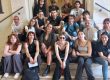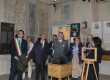


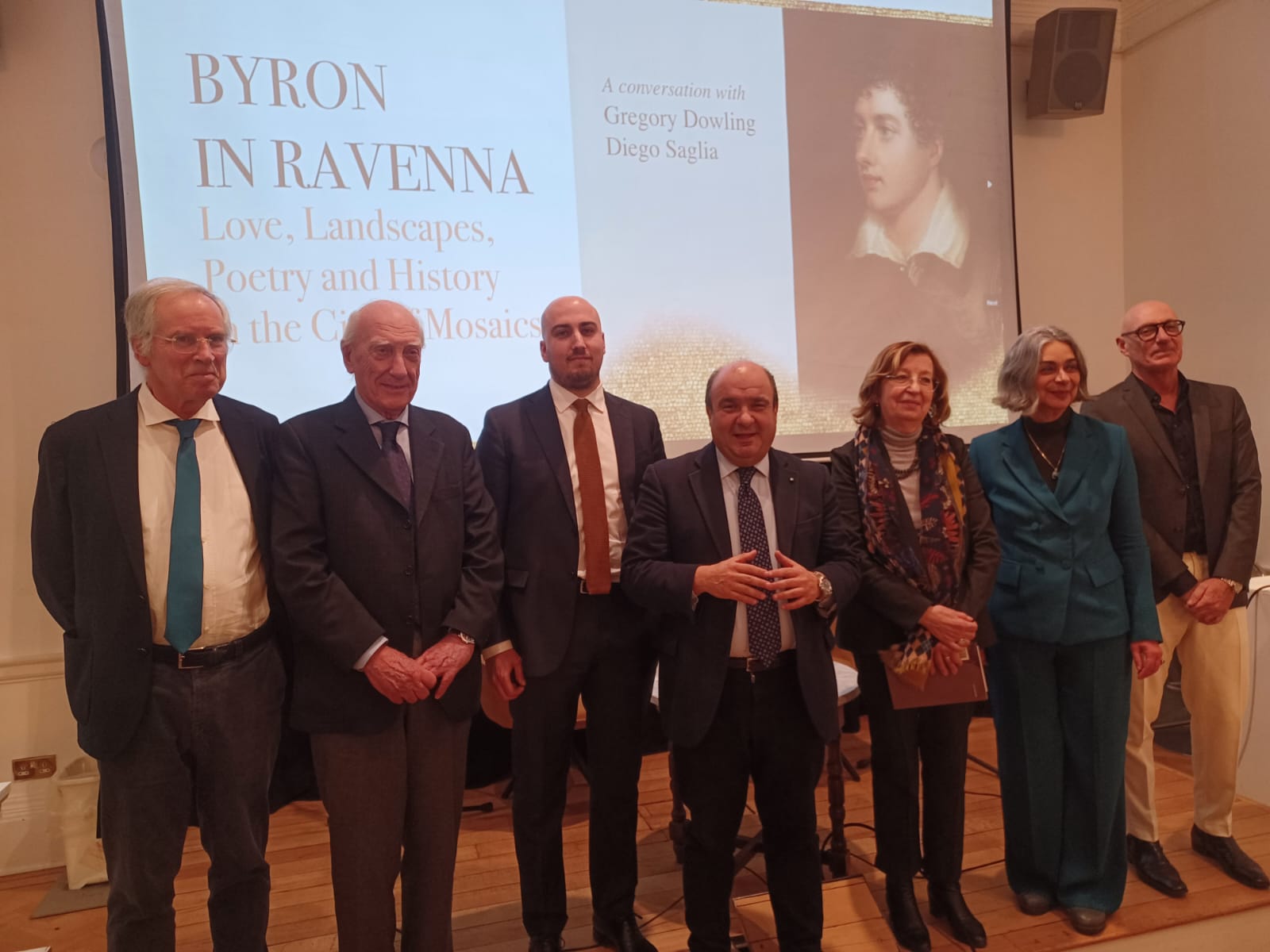
The grand staircase of Belgrave Square leading to the conference room of the Italian Cultural Institute in London was already crowded at 5:30pm: countless figures from Italian and international culture have spoken here, from Primo Levi to Mario Soldati, from Umberto Eco to Marina Warner. And for today’s event, starting at 6pm, the 102-seat hall had been sold out for days: “Byron in Ravenna: Love, Landscapes, Poetry and History in the City of Mosaics,” celebrating the first anniversary of the Byron and Risorgimento Museums in Ravenna and strengthening ties between Ravenna and London. The two cultural capitals are also united by the great master of English Romanticism, to whom the Fondazione Cassa di Risparmio di Ravenna dedicated a museum a year ago—recently visited by King Charles and Queen Camilla.
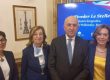
The conference opened with welcoming remarks by the Director of the Italian Cultural Institute, Francesco Bongarrà; the President of the Fondazione Cassa di Risparmio di Ravenna, Mirella Falconi Mazzotti; the City of Ravenna’s Councillor for Culture, Fabio Sbaraglia; the President of the Italian Byron Society, Ernesto Giuseppe Alfieri; and the Head of the Tourism Department of the Municipality of Ravenna, Maria Grazia Marini.
“We are particularly proud and pleased to be here today in London,” said Mirella Falconi Mazzotti, “and I thank the Italian Cultural Institute in London and the Municipality of Ravenna for promoting this extraordinary event. Our Museums are visited every day by large numbers of visitors, with a high percentage of English guests. This event, held in such a prestigious venue, further strengthens the bond between Ravenna and the United Kingdom in the name of great culture.”
“One year after its opening,” said Councillor Sbaraglia, “the Byron and Risorgimento Museums confirm themselves as a centre of cultural excellence and a major tourist attraction, not only conferring extra value on a place that has a special meaning for Ravenna, but also creating further opportunities for international promotion.”
The event featured a conversation between the two Vice Presidents of the Byron Society, Diego Saglia and Gregory Dowling—Byron scholars and university professors of English literature—who were warmly applauded by the audience. Diego Saglia highlighted “the uniqueness of these Museums, both for the objects on display and for the extraordinary multimedia narrative, but also for the magical atmosphere in the rooms and the fascinating stories hidden in every corner. What particularly strikes visitors is that the Museums are set in a historic city centre that is still very similar to what it was in the time of Byron and Teresa.”
Gregory Dowling emphasised a theme particularly dear to Antonio Patuelli, President of the Cassa, and creator, along with Donatino Domini and Claudia Giuliani, of the Museums: Byron gave the Italian Risorgimento powerful worldwide resonance, bringing attention to its protagonists and events, and linking it to the broader struggle for freedom and independence that united many movements of that era. “It should be stressed,” Dowling said, “that the events took place precisely in the locations where the Museums now stand. The connection between Byron and the Risorgimento is very strong—both in the poet’s life, as he later went on to fight for freedom in Greece, and in the great history of those years, when the Carbonari, with whom Byron was closely associated, and the early revolutionary uprisings gave decisive momentum to the cause.”
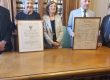
Among those present at the conference were Serena Corti, Deputy British Consul in Milan; Claudia Giunchiglia of the British Embassy in Rome; and John Lytton, Fifth Earl of Lytton, a direct descendant of Lord Byron through his daughter Ada. Lord Lytton proposed lending the Museums a valuable plaque commemorating the poet’s sacrifice for the freedom of Greece, following the precious gift of Byron’s walking stick donated a few months ago by the current Lord Byron and now on display at the Byron and Risorgimento Museums.
London, January 27, 2026